Tuesday, May 10, 2016

Star Wars Battlefront: A Player's Postmortem

Star Wars Battlefront (SWBF) is the most angering game that I’ve played in years.  Its predecessor is and was one of my favorite games of all time.  I played hours of the single player, Galactic Conquest mode.  I may have gotten more playtime out of that than almost any other game on the Playstation 2.  I did play some of the online modes and it’s actually the reason I purchased the network adapter for my launch-version PS2.  The hero battles and fleet battles of Battlefront 2 were my introduction to online gaming.

I loved the online competitive aspect of Battlefront 2.  Nothing I say here should be considered a condemnation of those aspects of the new Battlefront.  The problem for me lies in that those aspects of the game are not well designed enough to justify the exclusion of a TRUE single player mode.  It makes me wonder what they were doing with all of the development time that they had other than making things look and sound pretty (which they very much do).  While my largest complaint about the game is about what they did not include, let’s start by taking a look at the game that they did provide.
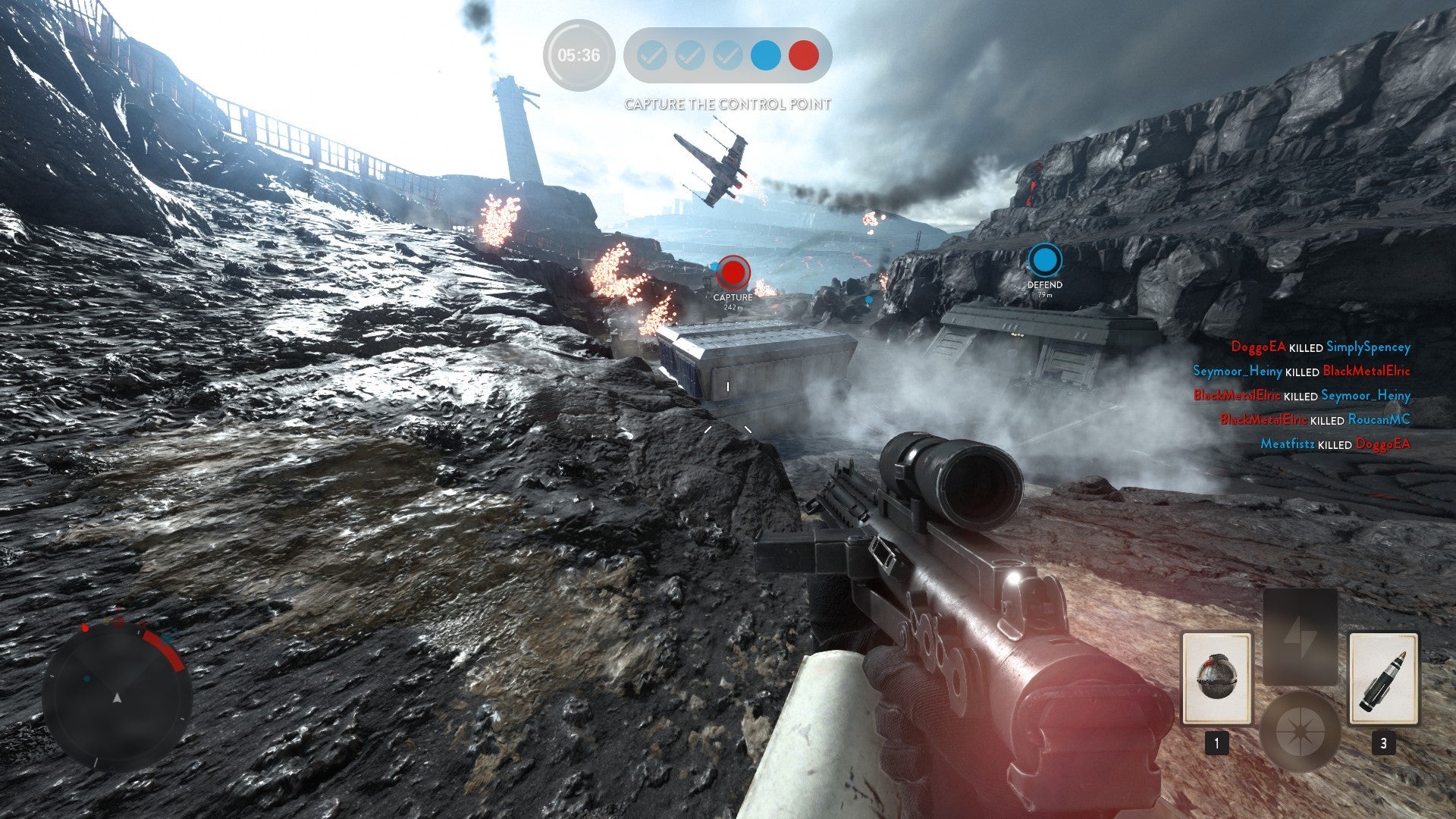
The overwhelming bulk of the game is an online, team-based, objective-based, multiplayer shooter. The skeleton of the game is great.  The main two modes, Walker Assault and Supremacy are very sound.  When you look at the game beyond those basic modes and the moment to moment shooting mechanics, the game quickly shows why it is so easy to be disappointed.

As a multiplayer, objective-based team game, one would think that team coordination would be the key to success in the game.  In a misguided attempt to combat the often toxic communities that inhabit online games, SWBF only allows voice communication between party members.  That means the opportunity to coordinate teamwork is non-existent unless you come to the game with premade group.  A coordinated group will almost always steamroll a team of uncoordinated lone wolves.  The idea that a team running into a coordinated group (or just a better team) would not have a chance to counter through on-the-fly coordination of its own is an insane design choice to me.  Sure, you could form groups for each game, but you would basically have to do it for each game, adding and removing players that leave, join or change teams.  That is completely unrealistic.

On top of the fact that they did not put any voice communication in the game, they did not even provide any canned communications such as a “defend here” or “attack here” automated communication or emote.  I understand that they made a design choice to try and deal with the often toxic communities that develop around online games, but in doing so they have completely undermined what their game is supposed to be.  Instead of letting the players use the opt-out option that was the “mute” function, they have created practically insurmountable barriers to opting into communication.  They were not done undermining the game yet though.

If the almost complete lack of in-game communication does not encourage team play, the way that the game tracks and highlights statistic actively encourages deathmatch style play.  The first and most prominent state you see after a game is who scored the most kills.  Kills are not how you win in most modes of SWBF, so there is no reason it should be highlighted as it is.  Attacking and defending objectives should be the primary, if not dominant statistic and basis for individual reward.  The only reward for team play in SWBF is winning, and too many people seem to want to play games like these for individual personal statistics and glory more than winning.  Players should be penalized for playing objective modes like a deathmatch, and they should be rewarded for playing the game they way it was designed.  Don’t like it?  Go play deathmatch!

Then, there is the actual team construction.  I know that matchmaking is difficult and there are not many games that manage to get it even close to right.  In a complicated team game like SWBF, there is no way to call the task easy.  I’m not sure how hard they tried.  Every game seems to be a romp, especially months after the game’s release.  One team typically steamrolls the other team.  Then, the sides switch and you do it again in reverse.  There is no team rebalancing, so there is usually an exodus from the losing team which just compounds the problem.

DICE has sabotaged multiplayer at almost every turn, which is nearly criminal since there is no legitimate single player mode to speak of.  
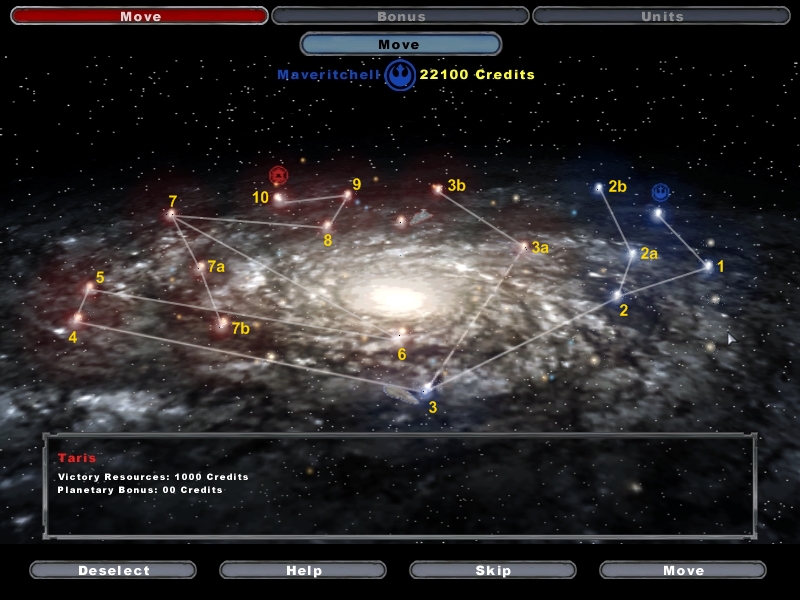
Galactic Conquest Galaxy Map
The PS2 game had an actual single player campaign (which I probably played but do not remember), as well as a “Galactic Conquest” mode, featuring a galaxy map and some basic strategy elements.  Players maneuvered their fleets around the galaxy, fighting battles for planets and in space (more on that later) in order to move through the galaxy.  Galactic Conquest provided me with countless hours of fun before I ever bought the broadband adapter for my PS2.  
A decade later, I cannot retreat from the mess of the online game to play any single player version of the game with any meat.  Of course, you might not notice the difference between online and offline play, since the communication level is about the same.  Instead, the closest thing they give you is a crappy version of the “Spec Ops” mode from Call of Duty.  So, if you want to play the actual game, you have one option: hop online with the voiceless humans who might as well be AI for all it matters.  As unfortunate as that is for its own sake, it turns the game into a meat grinder if you, God forbid, you fail to play for a week or two.  I do not know anybody who has been able to step away from a multiplayer shooter for any notable period of time and not fall behind the curve.  For those of us who are not good at them to begin with, step away for a month and you might as well sell the game for all the fun you will have if you try to go back.  (This happening to me with SWBF is actually what prompted me to get angry enough to write this, in fact.)

In fairness, the “falling behind the curve” problem is not unique to SWBF. Most other games in the genre at least TRY to have a legitimate single-player component.  It is not even as though DICE had to reinvent the wheel.  They had the perfect template for what to do with Battlefront 2.  Instead of paying any homage to the heritage of the game and solving one of the genre’s massive problems in the process, they doubled down.  They even had a more modern inspiration they could look to in the form of AI soldiers akin to the “creeps” we see in so many MOBA inspired games. In a game like SWBF, creeps could fill out the battlefield and give less skilled or acclimating players a way to be useful. None of that was mutually exclusive to what DICE wanted to do with the multiplayer game.  Hopefully DICE can take the hint that the game people have been asking for for 10 years is actually the game they wanted and that the game they gave us is not.  I have my doubts, as the game sold through the roof and that would be all EA would really care about.  On the other hand, they may recognize that they only get to ride on nostalgia once.

There are a series of other issues that do not warrant detailed analysis, but I cannot ignore:  
  • The token system for power-ups and vehicles was a mistake.  In a game so focused on getting the look, feel and sound of Star Wars right (and doing a FANTASTIC job for the most part), arcade style power ups are utterly immersion breaking.
  • The time spent on numerous game modes was completely wasted.  The time would have been better spent on more maps and planets for fewer core modes.  Those would be far more enjoyable to far more people than several niche modes that few people actually play.
  • If they were going to include a bunch of additional modes, the absence of space battles is just dumbfounding.  It was abundantly clear to anybody paying any amount of attention that space battles were a big deal to people excited for the game.  DICE was clear relatively early that they would not be in the game, but they seemed to think that their ship combat offering would scratch the same itch.  They didn’t.  The dogfight mode they did make was so shallow that it makes me wonder if it was tacked on after the internet blew up over the lack of space battles.
  • The abandonment of a true class system was a mistake.  The inclusion of support classes would be another way for those getting back into the game, or not that good at it to begin with, to be useful.  Since support mechanics require teamwork, the elimination of classes probably became all but a requirement once DICE decided to basically eliminate voice communication.  

I have no idea what goes into making a game.  To a certain extent, I do not care.  What I care about is the end product.  SWBF is a disappointing end product.  EA and DICE are two of the most accomplished names in video games.  I refuse to believe that they could not have done what was needed to make this game great.  Instead, it ended up being a nostalgia driven flash in the pan that’s reflective of both of their greatest recent problems.  EA has become infamous for employing the most cynical money-making tactics in games they publish.  DICE, repeatedly fails to realize the potential of their games due to an inability to calibrate their ambition and focus. Instead of solving problems and giving players the extras they want, they veer off in directions that either nobody cares about or detract from things that people care about more.  DICE may say that their metrics show that they made the right calls about what the included because, for example, relatively few people played the single player stuff.  That is because they were steaming piles of crap caught in a dumpster fire, not because we did not want them.  It is not clear to me that DICE knows why people like or dislike their games or their competitors games.

No developer is as good at taking fantastic core mechanics and concepts and packaging such trash around them as DICE.  In fact, I believe this game would have been universally well received if it had package Walker Assault mode, Supremacy mode, and the ship combat mode and sold the game as a $30 or $40 game.  In terms of actually enjoyable content, SWBF does not actually provide much more than Battlefield 1943.  

For a game that I wanted for so long and is so good in so many important ways, I am completely shocked how how little I want to play the game now.  As it stands, I can only hope that EA and DICE learned something from the mistakes they made in selecting their priorities for SWBF and that the recently announced follow up effort is more well received.  If they do not take the lessons, I would rather they simply let the franchise die, because it will not be worthy of the Battlefront name.

Saturday, April 23, 2016

The Playstation NEO is real... for some reason

Featuring a faster processor, faster RAM and an upgraded GPU, the Playstation NEO (as it’s being called), is rumored to be on the way later this year.  The best available details on the upgraded console were recently obtained by Austin Walker of GiantBomb through some apparently developer-oriented documents from Sony.  You should check out the GiamtBomb story for the full details.  It’s worth noting that Sony is yet to even publicly confirm the existence of the console, let alone explain its reasoning for creating one.  That said, it’s going to be an extremely tough sell for people like me, even though I do like enjoy having the “new shiny.”

While Sony looks to be upgrading the hardware of the Playstation, it appears they are taking massive steps to avoid fragmenting the user base.  They’re doing this by limiting how developers can utilize the new power and requiring not only support for both the Neo and original version of the console, but requiring almost complete feature parity for games.  This is probably the most consumer-friendly way this new hardware could be introduced, but it still strikes me as a self-defeating move.

There are unlikely to be improvements beyond graphical improvements and possibly better load times.  While these are worthwhile things to look for, my belief is that the people who prioritize those things over the traditional benefits of a console are already playing their games on PC.  The ones who don’t prioritize them aren’t going to want to spend three or four hundred dollars on a new console that plays the same games as the machine they have.

Looking at this without the benefit of explanation from Sony, this machine looks like it’s aiming to serve two masters but serving neither of them well.  It gives up the uniformity that is often the appeal of console games for consumers and developers because of the simplicity it brings.  In exchange for that sacrifice, it does not appear to add the customizability or raw power that PC gaming offers.  There has been speculation about what advantages this the NEO could provide.  Possibilities include an improved Playstation VR experience or even that the new hardware, along with the NEO mode all games will be required to have, could help facilitate backward compatibility with Playstation 4 games on the inevitable Playstation 5.  That remains all guesswork since Sony has not said a thing on the subject.

I’m curious to see how Sony explains this new Playstation to the gaming masses.  They have their work cut out of them because so far it just looks like a solution in search of a problem and I do not appear to be alone in that thinking.  One thing is certain:  Sony is playing with fire by allowing this information to be leaked and to let the speculation go on for so long without stepping in to calibrate expectations.

Monday, April 4, 2016

Star Citizen and Elite: Dangerous- Complimentary, Not Competitive

Everything that I’m about to say could be summed up with one sentence:  Star Citizen makes me want to play Elite: Dangerous, which makes me want to play Star Citizen.


(Disclaimer: My impressions of Elite are based entirely on the base game with the free updates and does not include any paid DLC or expansions.  I’ve not played any of that, so I cannot take it into account.)


At first glance, this proposition may seem counter-intuitive.  These games are, in a large sense, competitors.  They are the vanguard of a resurgence in the space-sim game genre that has occurred over the past few years.  You might think that the competition wouldn’t leave enough room for these two major competitors to coexist, let alone benefit each other, but I think they do.  It’s greatly helped by the very different approaches to the construction of the games.


Gladius in flight in SC's "mini-persistent universe"
Just to set things out generally, while they are both space-sims, they do many things differently.  To me, it starts with the design aesthetic.  Elite stays true to its original design aesthetic of an 80s vision of the future (much like star wars was a 70s vision of the future), while SC feels more modern and sleek.  Neither is better than the other, but I definitely prefer the feeling of stepping into a modern high tech aircraft that I get in SC as opposed to the retro future of Elite where you take control of a series of flying triangles.  To be fair, the ships have gotten more diverse recently, but still nothing compared to the diversity of design in SC, at least in my opinion.


There are also a fairly massive difference in the design philosophy.  While both aim to be massive sandbox games, they’re taking different routes to get there.  Elite has taken the path of building a massively wide sandbox that it is not working on deepening.  The galaxy is huge and the basic mechanics are all functional, but many of them seem hollow.  For instance, mining is what I’ve been doing when I’ve been playing recently.  Originally, mining was really simple.  Use mining laser on rocks, scoop them up, refiner module refines them, return to port and sell the refined products.  It’s actually gotten better from what it originally was.  The introduction of drones for prospecting and collecting makes mining significantly more fun.  The problem is that it doesn’t seem like the activity has any real impact on the game’s underlying simulation.  The exception to that would be when it contributes to a community goal, but that’s something that feels staged rather than organic.


That’s what it boils down to.  The activities in Elite do not feel like they actually impact the world, which is something that I want when I play a game like this.  The introduction of the Power Play mechanic seems aimed at addressing that type of concern, but I’d be lying if I said it felt like it was changing any of the things I care about.  Frankly, I haven’t noticed it at all, but I’ve never been one to get invested faction politics in these types of games.  Elite in particular just feels too big to be able to get involved in what’s going on unless you’re willing to take the hours it takes to get to where the hotspots are and I just don’t have that type of time.


In a game as large and open as Elite, I need direction.  This is where Elite fails utterly.  The mission structure is absolute garbage.  Missions are the absolute worst way to make money and they feel entirely arbitrary, as though when you arrive in a system a random list of simple missions is generated that have nothing to do with where you are.  For anybody interested in making money or earning better ships, your best bets are bounty hunting, mining, or using an outside tool to assist you with trading.  Those things just feel grindy.  It’s not a bad grind as grinds go. I’ve enjoyed mining and I’ve enjoyed bounty hunting, but doing these things never feels like I’m interacting with the world or even part of a story of any consequence.


On the other hand, SC has focused its development on developing deep mechanics before building a large universe.  Had they done the opposite, they likely could have released the game by now.  Focusing on the deep mechanics first and expanding the universe as they go means that, theoretically, my complaints about Elite will be addressed in SC when it’s done.


For example, say I want to buy parts for my ship.  It could be a powerplant, guns or even missiles and ammo.  The economic simulation that SC is aiming for means that I will need to find a retailer that sells what I need (potentially another player).  That retailer will need a supplier.  Whether there are middlemen or the retailer is supplied directly by the manufacturer, a manufacturer would be at the base of the supply chain.  To get items from any point on the supply chain to another, someone would have to actually bring the items from one place to another.  There would need to be a manufacturer from where the items would originate and that manufacturer would need to source component parts or raw materials as well.  So, miners, extractors or sub-manufacturers would be needed to provide what’s needed.  Once again, someone needs to bring components from their place of origin to the manufacturer.


The idea is to simulate real supply chains in addition to supply and demand instead of just faking it like so many games seem to.  Supply and demand for the finished product not only impacts the price of the final product, but also for all of the goods and services that go into its creation.  This matters because SC is intending to generate missions based upon the needs of the economy.  If more iron is needed to meet demand, mining missions will be generated, as will missions for transporting the iron to a refiner, or form a refinery to a factory.  If pirates are a problem, missions to escort and protect trade ships will be generated.  Players are supposed to be able to participate in most, if not all aspects of the economy, but NPCs would pick up the slack where players aren’t meeting the needs of the simulation.


It’s an incredibly ambitious goal for a game, but one that would be borderline revolutionary if it’s achieved to any significant degree.  None of it will matter if SC fails in the same way that Elite does though.  If these missions don’t feel like they actually have anything to do with the economy or, worse, they aren’t worth doing because the rewards are insignificant.  Fun is king, and in a game as big and open as a sandbox space sim, some direction is helpful to those of us who get lost in that type of game but still want to be part of the world.  Mission can broaden the appeal of a sandbox game without necessarily sacrificing what the game is at its core.


None of this is in SC as it exists now.  What is there is fantastic, bugs and all.  Those deep economic systems are not in, so Elite’s offers more in the way of economic game play at this point.  I enjoy playing the alpha build of SC because the universe feels more real to me insofar as it exists so far, but there isn’t a ton there yet because the foundational elements are still being crafted.  I’ve enjoyed going back to elite to satisfy my desire for economic involvement in a space universe, but the lack of depth (at least as far as I perceive) leads me to pining for a finished SC after a few hours with Elite.  This is why SC makes me want to play elite, which makes me want to play SC.


None of that is to say that Elite is bad or incomplete.  I’ve enjoyed my time with the game too much to say that.  I’ll never be able to put the energy into the game to find out if the Power Play mechanics would scratch the itches that I feel like the game leaves, so I admit my opinion is incomplete.  My hope is that the planned structure of SC leaves the game more approachable for people like me, creating the classic “easy to learn, difficult to master” game dynamic that is truly one of the Holy Grails of game design.


Until that question is answered, and possibly after, I’ll continue to go back and forth between Elite and SC and enjoy each one for what it offers.

Saturday, January 23, 2016

No Phantom Pain, Just Intro Pain

Unlike what MGSV does, I'd like to hit the ground running with this blog, so let's jump right in.

I'm approximately 20% through “Metal Gear Solid V: The Phantom Pain” and thoroughly enjoying my time with it.  The game has been out for months now but I did not buy the game right away.  My experience with the Metal Gear franchise consists of playing the first level of Metal Gear Solid a few times.  I dabbled in "Snake Eater" and actually put a few hours into that game.  It never got its hooks in me as much as I liked the idea of it.  "Tactical espionage action."  What's not to like?  Honestly, I don't know, but somehow it didn't grab me.  The reaction to this game got me really interested though, so I decided to give it a shot.

“The Phantom Pain” has its hooks in me.  The open world, free-form approach to completing missions, the companions, the base building and upgrade system... So far, I'm enjoying it all.  I have some criticisms such as the fact that the mission grading system cannot be hidden or disabled (don't judge me, game) and that the Skulls rely on being bullet sponges for the majority of their difficulty, but my complaints about the game are overwhelmed by my enjoyment of what it brings to the table.

I almost didn't get the chance to love it.